
Jacobi CH20 ion exchange resin is supplied by package volume or weight. The actual filling volume needs to be calculated based on the influent heavy metal concentration, target effluent standards, design flow rate, and contact time. Please contact 瑞順 for confirmation of packaging specifications, minimum order quantity, and delivery time.
PRODUCT INFORMATION
Jacobi CH20 Ion Exchange Resin | Chelated Weakly Acidic Cation Exchange for Heavy Metal Removal
- front page
- product
- Technology Development Department
- For desalination
- Jacobi CH20 Ion Exchange Resin | Chelated Weakly Acidic Cation Exchange for Heavy Metal Removal
Product Information
- heat treatment
-
water treatment
- Deaerator
- Desulfurizer
- Arsenic remover
- Water softener (calcium and magnesium ion removal)
- Carbon filter (removes odor and residual chlorine)
- Sand filter (removal of suspended impurities)
- Iron remover (removal of iron and manganese ions)
- RO water purifier
- Pre-backwash filter
- UV ultraviolet sterilizer
- Ion exchange resin
- reverse osmosis membrane tube
- quick filter
- Various tanks for water treatment
- Various application filter media
- 美國 Clack Clark control valve
- 美國 Fleck Control Valve
- 美國 Pentair Control Valve
- 美國 Autotrol Control Valve
- Runxin Control Valve
- Injection treatment
- Technology Development Department
-
brand
- Qin Sen
- 義大利 ATLAS
- 日本 TOHKEMY
- 義大利AQUA
- US DOW
- IDEX USA
- US CLACK
- EMERSON, USA
- American PENTAIR
- SIEMENS Germany
- American PULSAFEEDER
- Denmark DANFOSS
- Thailand HAYCARB
- France SUNTEC
- UK PUROLITE
- Japanese NOP
- Japan OLYMPIA
- Japan KATSURA
- BRAHMA, Italy
- SAGINOMIYA
- HONEYWELL
- AZBIL (YAMATAKE)
- OLTREMARE
- NIPCON
- TROCHOID
- domestic
- EGO
- KATO
- LECIP
- Taiwan ATS
- JACOBI
- ETATRON
- WAVE CYBER
- BOSCHINI
- NIPPON
- WL
- CASH ACME
- YAZAKI
- RUNXIN
- About | Contact
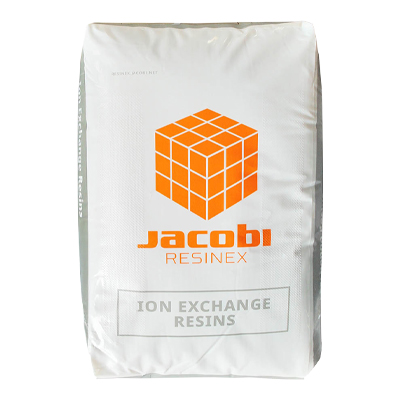
Industrial wastewater heavy metal removal, effluent control, and metal recycling processes Jacobi CH20 Ion Exchange Resin | Chelated Weakly Acidic Cation Exchange for Heavy Metal Removal
It selectively adsorbs heavy metals without competing with large amounts of calcium and magnesium for exchange sites.
Jacobi CH20 (original manufacturer's model Resinex™ CH-20) is a chelating, weakly acidic cation exchange resin with a cross-linked polystyrene-divinylbenzene base material. Its functional groups are selective for heavy metal ions. It is suitable for heavy metal removal from industrial wastewater, heavy metal control in effluent, and metal recovery processes. A uniform particle size version, CH-20 UB, is also available. 瑞順 is the sole distributor of Jacobi in Taiwan.
The discharged water contains excessive heavy metals, which cannot usually be removed using ordinary resins.
The concentration of heavy metals in industrial wastewater is usually not high, but the concentrations of calcium, magnesium, and sodium in the background water are often several orders of magnitude higher. Typical strong acid cation exchange resins exchange ions by electrostatic interaction and lack selectivity. The resin bed will be preferentially filled with large amounts of calcium and magnesium, while the copper, nickel, lead, and cadmium that are actually to be removed will instead permeate and flow out.
In practice, the result is that even with an overestimation of resin dosage, the heavy metal content in the effluent still fails to meet standards; or, in an attempt to meet standards, the regeneration frequency is increased to an unreasonable level, leading to uncontrolled costs for reagents and wastewater treatment. This is why chelating resins, rather than general ion exchange resins, must be used for heavy metal treatment.
Why can chelating resins pick out heavy metals?
The difference between chelating resins and general ion exchange resins lies in their functional groups. The sulfonic acid or carboxylic acid groups in general resins only provide potential sites and attract ions by electrostatic attraction; while the functional groups in chelating resins can form coordination bonds with metal ions, simultaneously capturing metal ions from two or more sites.
The strength of this coordination binding is far greater than that of simple electrostatic interactions. Therefore, even with high concentrations of calcium and magnesium in the water, the chelating resin will preferentially bind to heavy metals. In practice, this means two things: first, it can maintain removal efficiency even in high hardness environments; and second, it can achieve the same treatment goal with a smaller resin bed.
During regeneration, acid is used to desorb metal ions. The concentrated regenerated waste liquid has a high metal concentration and has recycling value in some processes.
Jacobi CH20 Product Positioning
+ Chelating functional group, selective for heavy metal ions
+ Weakly acidic cation exchange resin, which can function in high-hardness background water.
+ Cross-linked polystyrene divinylphenyl material, spherical particles
+ Also available is the CH-20 UB uniform particle size version, suitable for applications with high requirements for pressure loss and exchange belt width.
How to choose the CH series models
Jacobi's CH series are all chelating resins, but their selective metals and applications differ:
+ Jacobi CH12 Ion Exchange Resin
+ Jacobi CH23 Ion Exchange ResinSuitable for the removal of cadmium, zinc, copper, chromium, mercury, lead, gold, silver, and cyanide complexes.
+ Jacobi CH80 Ion Exchange ResinHigh-purity weakly acidic cations with high selectivity for mercury; also effective in removing silver, copper, lead, nickel, cobalt, and cadmium.
Applicable fields
+ Heavy metal removal from electroplating and metal surface treatment wastewater
+ Final oversight of water discharge heavy metal control projects
+ Recycling and concentration of precious and valuable metals
+ Deep removal of trace metals from process water
+ MatchingVarious tanks for water treatmentandcontrol valveComposition of fixed bed system
If the initial stage still requires general softening or desalting, please refer to...Ion exchange resinOther models in the category.
 繁體中文
繁體中文  English
  日本語
日本語