
PRODUCT INFORMATION
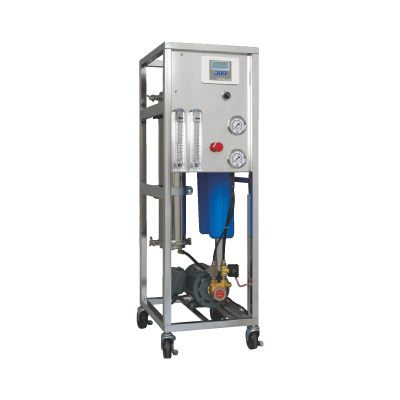
Industrial RO reverse osmosis pure water machine (3000 GPD)
- front page
- product
- water treatment
- RO water purifier
- Industrial RO reverse osmosis pure water machine (3000 GPD)
Product Information
- heat treatment
-
water treatment
- Deaerator
- Desulfurizer
- Arsenic remover
- Water softener (calcium and magnesium ion removal)
- Carbon filter (removes odor and residual chlorine)
- Sand filter (removal of suspended impurities)
- Iron remover (removal of iron and manganese ions)
- RO water purifier
- Pre-backwash filter
- UV ultraviolet sterilizer
- Ion exchange resin
- reverse osmosis membrane tube
- quick filter
- Various tanks for water treatment
- Various application filter media
- 美國 Clack Clark control valve
- 美國 Fleck Control Valve
- 美國 Pentair Control Valve
- 美國 Autotrol Control Valve
- Runxin Control Valve
- Injection treatment
- Technology Development Department
-
brand
- 日本 NIKKISO
- Qin Sen
- 義大利 ATLAS
- 日本 TOHKEMY
- 義大利AQUA
- US DOW
- IDEX USA
- US CLACK
- EMERSON, USA
- American PENTAIR
- SIEMENS Germany
- American PULSAFEEDER
- Denmark DANFOSS
- Thailand HAYCARB
- France SUNTEC
- UK PUROLITE
- Japanese NOP
- Japan OLYMPIA
- Japan KATSURA
- BRAHMA, Italy
- SAGINOMIYA
- HONEYWELL
- AZBIL (YAMATAKE)
- OLTREMARE
- NIPCON
- TROCHOID
- domestic
- EGO
- KATO
- LECIP
- Taiwan ATS
- JACOBI
- ETATRON
- WAVE CYBER
- BOSCHINI
- NIPPON
- WL
- CASH ACME
- YAZAKI
- RUNXIN
- About | Contact
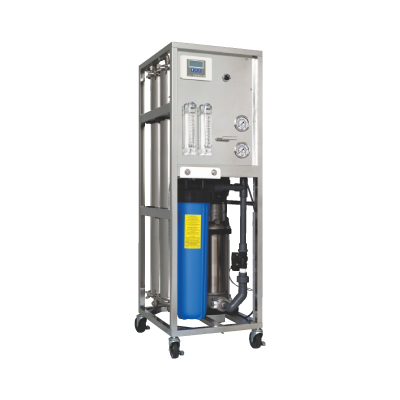
Industrial RO reverse osmosis pure water machine (3000 GPD)
RO reverse osmosis is one of the most effective water treatment methods in the existing technology. It can effectively and quickly remove salts, heavy metals, chemicals and pesticides from water to more than 95%. At present, it has been widely used in kidney dialysis water, electronic ultrapure water, packaged drinking water and other occasions
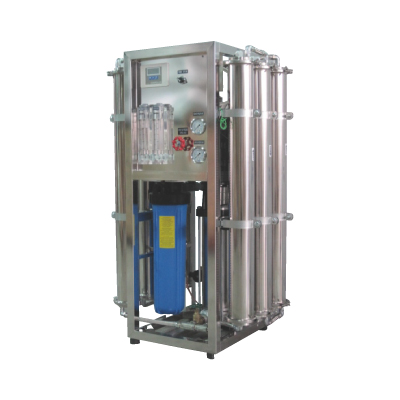
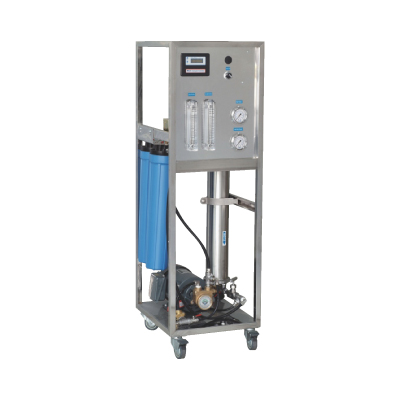
This product is matched with a vertical pump. There are 2, 3, and 4 4040 membrane tubes in series. The frame is generous, the membrane tube is not exposed, and the transportation is the most convenient. This model can be used in restaurants, schools, water stores, direct drinking water and industrial water.
basic configuration
Stainless steel main frame, open configuration, easy maintenance
RO shell adopts stainless steel high pressure tube shell or FRP tube shell
The operating pressure regulating valve is made of SUS 316 material, and the amount of pure/waste water is precisely controlled
Motor overload protection control device
The control system adopts microcomputer control
TDS liquid crystal display controller, can display water quality status and thirsty water, water production, full water protection functions
High-quality solenoid valve with water cut-off and automatic flushing functions
Danfoss pressure switch to ensure protection of the pump unit if the inlet water pressure is too low
The most space-saving exquisite design
Reverse osmosis (RO) is one of the most effective water treatment methods currently available. It can effectively and rapidly remove salts, heavy metals, chemicals, and pesticides from water, achieving a removal rate of over 951 TP2T. It is currently widely used in applications such as dialysis water, electronic ultrapure water, and packaged drinking water. (Technical explanation)
How to choose a 250–9000GPD "pure water machine"? First, let's consider... GPD Just treat it as a "car manufacturer's fuel consumption label".
Many people choose water purifiers and immediately focus on models with capacities of 250, 1000, or 9000 GPD—but a more accurate assessment is:GPD is mostly "ideal product water under standard conditions"..
Membrane specifications typically specify the test conditions clearly, such as 25°C (77°F), specific pressure, and specific recovery rate (the same membrane will produce different results under different conditions). Think of it like a fuel consumption label; it makes perfect sense.The fuel consumption of the same vehicle will vary depending on whether it is going uphill or downhill, in winter or summer, or with different loads.
The most common problem encountered on-site, "insufficient water production," is usually not due to machine malfunction, but rather these factors that reduce water production:
Water temperature, pressure, recovery rate, raw water quality (TDS/hardness/colloids/metals/residual chlorine, etc.).
The water temperature is particularly noticeable.It's normal for water production to decrease slightly for every few degrees the water temperature drops.Winter often means "the same machine, two different lives".
Step 1: First, intuitively convert 250–9000 GPD into "per hour/per minute".
What you really need to grasp is... Peak water usage:
Do you use it slowly throughout the day, or do you use it rapidly in a short period of 10 minutes? This will determine whether you choose direct output, water storage, or a combination.
| GPD (Gross Productivity) of a Pure Water Machine | Approximate water production (L/day) | Approximately continuous water production (L/hour) | Approximate average flow rate (L/minute) | Intuitive advice (water discharge strategy) |
|---|---|---|---|---|
| 250 | 946 | 39.4 | 0.66 | It's almost always necessary to use a water tank (you'll be very breathless if you go straight out). |
| 500 | 1893 | 78.9 | 1.31 | Water storage tank + stable low-flow direct output |
| 750 | 2839 | 118.3 | 1.97 | Demand is stable and can be met directly; however, water storage is still recommended during peak periods. |
| 1000 | 3785 | 157.7 | 2.63 | Small direct output is fine; peak/continuous water use with water storage is more reliable. |
| 1500 | 5678 | 236.6 | 3.94 | Direct output + buffer tank (like adding a "reservoir") |
| 2000 | 7571 | 315.5 | 5.26 | Direct output is preferred; a buffer water tank is strongly recommended. |
| 3000 | 11356 | 473.2 | 7.89 | Almost all of them will be equipped with direct output + water tank + automatic water replenishment. |
| 4500 | 17034 | 709.8 | 11.83 | Direct output + water tank + voltage regulator/frequency converter, more like an industrial configuration. |
| 6000 | 22712 | 946.4 | 15.77 | Piping, emissions, and backup systems all need to be considered from an "engineering" perspective. |
| 9000 | 34069 | 1419.5 | 23.66 | Industrial small system level: Water tank, CIP, and monitoring are basically required. |
A friendly reminder: This is a "continuous average" concept. Actual water production will fluctuate depending on water temperature, pressure, and recovery rate, and is usually more challenging in winter.
If the manufacturer provides a temperature correction chart or TCF (Temperature Correction Factor), be sure to use it to check your lowest water temperature.
Step 2: You are actually choosing between "direct output" and "water storage".
Choosing a water purifier is similar to choosing a meal service mode:
- Direct output typeFor on-demand processing, the equipment must be able to handle peak demand (pumps, membranes, pressure, and recovery rates all need to keep up).
- Water storage typeLike a central kitchen, ingredients are prepared first, peak flow is released through the water tank, and the water purifier replenishes it gradually.
In short: the sharper the peak, the more water tank is needed.
If you have a bursty demand like "equipment cleaning, instant water replenishment, and filling", ray tracing GPD can easily exceed your budget, and the result is still unstable.
Quick Decision Table: First, select a water strategy using "water usage pattern".
| Your water usage patterns | Common Situations | Recommended water discharge strategy | Important Reminder |
|---|---|---|---|
| Stable and continuous | Laboratory hydration, small-scale use in continuous processes | Direct output or small water tank buffer | Is it still sufficient when monitoring the lowest water temperature and lowest pressure? |
| Spike pulse | Cleaning, filling, and concentrated water use during certain periods | Water tank capacity expansion + RO inventory replenishment | Water tank capacity is generally more cost-effective and stable than "buying more GPD". |
| Long-term high load | Multi-shift system, continuous water intake of production line | Direct output + water tank + voltage regulator/frequency converter | Initially, the piping, drainage, and backup systems should be treated as a single project. |
Step 3: First look at the raw water. Focusing solely on GDP without considering the raw water is like buying a truck without checking the road conditions.
Is the reverse osmosis water purifier stable?The part before the membraneOften, this determines 80% of the final product. For raw water, at least these factors "directly affect membrane life and product water":
| Key factors of raw water | What problems will this cause? | Common countermeasures (directions) |
|---|---|---|
| Residual chlorine/oxidant | The membrane is easily damaged, and the desalination rate decreases. | Dechlorination with activated carbon or chemicals, ORP/residual chlorine monitoring |
| SDI/Turbidity/Particulates | Membrane blockage, increased pressure differential, and drop in permeate flow. | Multi-media filtration, filter cartridge grading, and UF/MF addition when necessary. |
| Hardness/Silicon | Recovery rate is stuck, and the risk of scaling increases. | Softening, scale inhibition, segmented design, and control of concentration ratio |
| Metals such as iron, aluminum, and manganese | Pollution, colloid/precipitation | Oxidative filtration, iron and manganese removal, and pH/coagulation condition review |
| water temperature range | Fluctuations in water production and changes in salt breakthrough trends | Check GPD and TCF based on the lowest water temperature, and reserve for winter. |
Literature or association materials often mention that increased temperature usually increases water production, but it may also increase salt penetration. If you are in a situation where conductivity/resistivity is very important, don't just be happy because "more water production" is achieved; quality must also be considered (for example, some educational materials from WQA often remind you of the impact of temperature on system performance).
Step 4: Calculate the influent and wastewater volumes using the "recovery rate" in one go.
Many people only realize this after they've bought it:Insufficient ground drainage, wastewater volume exceeding expectations, or raw water supply not keeping up..
Just memorize three lines of equations:
- Water inflow = Water production ÷ Recovery rate
- Concentrate/Discharge = Inflow rate - Production rate
- Recovery rate = Production water ÷ Inflow water
Small examples (to give you an instant feel for it)
| Target water production | Set recovery rate | Water needs to be introduced | It will discharge concentrated water |
|---|---|---|---|
| 1,000 L/h | 50% | 2,000 L/h | 1,000 L/h |
| 1,000 L/h | 70% | 1,429 L/h | 429 L/h |
Recovery rate isn't something you can just arbitrarily increase: the higher the recovery rate, the better.The higher the risk of scaling/contaminationMore often, staged design, scale inhibition strategies, or more complete pretreatment are needed; otherwise, the water you save may be returned by "membrane washing, shutdown, and membrane replacement".
Step 5: Different "pure water machine configurations" with the same GPD can vary greatly (these are the ones you should compare).
While both are rated at 1000GPD, the "ease of use" of manufacturers A and B can differ as much as two cars from different segments. When choosing a system, it's recommended to compare them based on their individual performance metrics:
- Membrane elements and test conditionsSame as GPD, but different testing pressure/recovery rate, resulting in significant differences in field performance.
- Temperature Correction Factor (TCF)Did you provide a set of calculation and comparison correction tables?
- Preprocessing completeness: Sand, colloids, metals, hardness, silicon → Are the corresponding filtration/softening/chemical injection strategies in place?
- Monitoring and ProtectionDifferential pressure, conductivity, low pressure/water shortage protection, flushing logic (these determine whether you're constantly putting out fires).
- CIP/Maintenance FlowAt speeds above 3000 GPD, without proper cleaning and maintenance planning, they can easily become "trouble-making machines."
If you want to quickly find a typical membrane specification sheet format, you can look at DuPont's membrane product information (it will write the test conditions and performance descriptions in a very neat way, which is very convenient to use as a comparison template).
Quick Selection Method for 250–9000GPD Water Purifiers: Match the type to your needs
- Demand is stable, use it slowly throughout the day.Choose a model that "slightly meets your immediate needs," and then use a small water tank for buffering.
- Demand is very high (volume spikes at certain times).Prioritize "water tank capacity release," with the water purifier responsible for replenishing inventory.
- You need higher purity (you need to connect to a mixed bed/EDI/UV system).First, stabilize the RO system (pretreatment, recovery rate, monitoring), then the subsequent stages will stabilize.
The 5 most common pitfalls (you'll usually fall into at least one of them)
- Looking only at GPD, ignoring test conditions(The numbers will not be the same if the temperature, pressure, and recovery rate change.)
- Insufficient water production in winter(TCF verification was not used at low water temperatures)
- In an attempt to save water by setting the recovery rate too high, scale buildup and constant membrane cleaning occurred.
- Preprocessing omitted(Sand, colloid, metal, hardness, silicon... all are ultimately counted on the membrane head)
- Emissions/ground discharge not calculated first(Only after purchasing did I realize that the concentrate volume exceeded the site conditions)
10-Second Self-Check Checklist (Prepare these 6 numbers, and choosing a water purifier will be much easier)
- What you want Water production: L/day + Peak L/minute
- raw water TDS / Hardness / Silicon / Iron, Manganese, Aluminum / Residual Chlorine(You can also check the hardness, residual chlorine, and TDS first.)
- raw water water temperature range(What's the lowest temperature in winter?)
- What you can accept Recovery rate(And emissions/ground discharge capacity)
- What grade of effluent is required (pure RO? or RO + mixed bed/EDI/UV?)
- you want Straight output,Water storage,still Direct output + water tank mixing?
Action Recommendation: To select the right specifications from the start, turn the "uncertain" into the "calculable".
If you are evaluating medium to high flow rates, or if you have peak water usage (cleaning, filling, replenishment), the easiest and most time-saving approach is not to keep replacing larger GPDs, but to put "discharge strategy + tank buffer + recovery rate + pretreatment" together on the same specification sheet, and the selection will suddenly become very clear.
Finally, if you're also working on softening/pretreatment and overall system stability (especially ensuring stable RO downstream quality), consider ATS's solutions to truly realize the principle of "stable upstream, stable downstream." To quickly align your scenario and needs, simply use their form to schedule a meeting and clarify your water usage patterns, raw water conditions, and target water quality all at once. This is usually more cost-effective than guessing specifications yourself.
 繁體中文
繁體中文  English
  日本語
日本語